How Efficient Are Solar Panels? A Comprehensive Guide to Solar Panel Performance
Solar panels are a cornerstone of the clean energy revolution—but how efficient are they, really? Whether you're planning to install panels at home or just curious about how they work across different conditions, this article breaks down what you need to know about solar panel efficiency in various scenarios.

⚙️ Solar Panel: How It Works
Solar panels work through the photovoltaic effect:
- Sunlight hits silicon cells.
- Electrons in the silicon are knocked loose, creating a flow of electricity.
- That electricity is captured by the circuit and converted for use in your home or devices.
The quality of the cells, panel construction, and environmental conditions all affect how efficient this process is.
🔍 What Does Solar Panel Efficiency Mean?
Solar panel efficiency refers to the percentage of sunlight that a solar panel can convert into usable electricity. For example, if a panel has 20% efficiency, that means it turns 20% of the sunlight it absorbs into electrical power. The rest is lost due to reflection, heat, and resistance in the system. Most residential panels today range from 15% to 22% efficiency. That means if 100 watts of solar energy hits the panel, it can generate 15–22 watts of power.
What Influences Solar Panel Efficiency?
Several factors influence how efficient a solar panel is:
- Cell Type: Monocrystalline panels are generally more efficient than polycrystalline ones.
- Temperature: Contrary to popular belief, solar panels perform better in cooler temperatures.
- Sunlight Angle & Hours: The direction and duration of sunlight exposure impact output.
- Panel Age: Efficiency declines slowly over time, typically by 0.5% to 0.8% per year.
- Shade or Dirt: Obstructions on the panel surface reduce energy production significantly.
Actual charging power is influenced by multiple factors, including the output parameters of the controller, sunlight intensity, the orientation and angle of the solar panel, environmental temperature, air mass, charging protocols, cable quality, and the maximum charging power supported by the connected devices. Additionally, some devices may accept different power levels at various stages of charging (for example, some appliances may reduce charging power when the battery level exceeds 50% to protect the battery).
In summary, nominal output power represents the theoretical maximum output of the solar panel under ideal conditions, as measured in the standardized STC environment.
Actual charging power, on the other hand, is influenced by various practical factors and may be lower than the nominal output power
How Efficient Are the Best Solar Panels Today? (2024–2025 Update)
The best solar panels on the market today are breaking new records in efficiency and durability, driven by innovations in cell architecture and materials.
✅ Top Commercial Panel Efficiency in 2025
As of early 2025, the highest-efficiency commercial solar panels—available to homeowners and businesses—are reaching up to 23.5%–24.5% efficiency, particularly those using N-Type TOPCon or IBC (Interdigitated Back Contact) cell technologies. These panels offer:
- Better low-light performance
- Lower degradation rates over time
- Higher energy yield per square foot
Leading brands like Longi, JinkoSolar, and REC are at the forefront, but newer players are catching up fast.
⚡ ZOUPW’s Edge: 16BB N-Type Panels
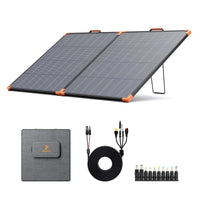
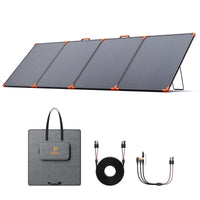
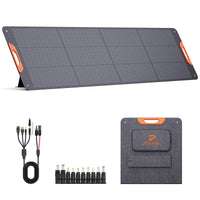
ZOUPW’s latest foldable and fixed solar panels leverage 16-Busbar (16BB) N-Type monocrystalline cells, which significantly reduce energy loss by shortening the path for electron flow. This results in:
- Greater reliability and lifespan
- Improved performance in partial shade or cloudy conditions
- Efficiency levels around 25%
These are among the best portable-use solar panels available for RVs, outdoor cabins, emergency use, and field work.

🌐 What About Lab-Tested Panels?
In laboratory settings, companies like SunDrive (Australia) and LONGi have achieved efficiency rates over 26% on silicon-based cells. Meanwhile, tandem perovskite-silicon cells have reached over 33% efficiency in research settings (e.g., by Oxford PV and MIT labs).
However, these panels are not yet commercially scalable due to high production costs and durability concerns.
How Do Solar Panels Perform in Different
🌥 How Efficient Are Solar Panels on Cloudy Days?
Cloudy weather doesn’t stop solar panels—but it does reduce their output. On overcast days, solar panels typically operate at 10% to 25% of their rated capacity. That said, high-efficiency panels perform better in low-light environments than standard models.
Pro Tip: Panels like ZOUPW’s 450W foldable series with N-type cells maintain better performance in variable lighting conditions.
❄️ How Efficient Are Solar Panels in Winter?
Cold weather doesn’t hurt panel performance—in fact, it may help. Solar panels operate more efficiently in cool temperatures, as heat can reduce voltage output. The real challenge in winter is shorter daylight hours and potential snow coverage. A well-installed tilted panel can shed snow quickly, maintaining energy production.
🛰 How Efficient Are Solar Panels in Space?
IIn space, solar panels are exposed to unfiltered sunlight and can achieve efficiencies of 30% or more using multi-junction cells. These are used on satellites and space stations but are not practical for terrestrial use due to cost and complexity. solar panels are exposed to direct, unfiltered sunlight, so they can achieve much higher efficiency—up to 30% or more with multi-junction solar cells (used on satellites and spacecraft). However, these cells are very expensive and not used in consumer products.
⏳ How Efficient Are Solar Panels After 10 Years?
Most panels degrade over time—typically 0.5% to 0.8% annually. After 10 years, a quality panel should still retain over 90% of its original efficiency. This makes them a long-term, sustainable investment.
Many manufacturers—including ZOUPW—offer 25-year performance warranties, ensuring long-term value.
📊 How Efficient Are Solar Panels Compared to Other Energy Sources?
Here’s a simple comparison:
| Energy Source | Typical Efficiency | Notes |
|---|---|---|
| Solar Panels | 15%–23% | Clean, quiet, long-lasting |
| Coal | 33%–40% | Polluting, non-renewable |
| Natural Gas | 45%–60% | High efficiency, but fossil-based |
| Wind Turbines | 35%–50% | Site-dependent, intermittent |
| Hydro Power | 90%+ | Very efficient but location-limited |
While solar panels aren’t the most efficient in pure conversion terms, they shine (pun intended) due to their zero emissions, scalability, and accessibility, especially when paired with storage solutions.

⚡ FAQ: Solar Panel Efficiency Explained
🔌 How to Maximize My Solar Panel Efficiency?
Install panels at optimal tilt and orientation.
Keep them clean of dust, snow, or debris.
Use MPPT charge controllers for better energy harvest.
Choose high-efficiency monocrystalline panels.
☁️ Do Solar Panels Work at Night?
No, they don’t produce electricity without sunlight. But with a battery storage system, you can store daytime energy for nighttime use.
☀️ Are Portable Solar Panels Less Efficient?
Not necessarily. high-quality ones can achieve similar efficiency to roof-mounted systems. ZOUPW’s portable solar panels use advanced monocrystalline cells , offering excellent performance for camping, RV, emergency backup, or off-grid use.
Their advantage lies in flexibility and mobility—you can take them anywhere and generate clean power even in remote areas.

🌍 Final Thoughts: Is Solar Efficient Enough for You?
The answer is yes—for most homes, RVs, and off-grid setups, modern solar panels are efficient, reliable, and environmentally friendly. Whether you’re using rooftop arrays or foldable panels like those from ZOUPW, solar efficiency today is high enough to meet a variety of power needs, all while reducing your carbon footprint.
💡 Looking to explore high-efficiency solar solutions for your home, RV, or outdoor adventures?
Check out ZOUPW’s full range of N-Type and portable solar panels—built for performance, durability, and real-world efficiency.
Share